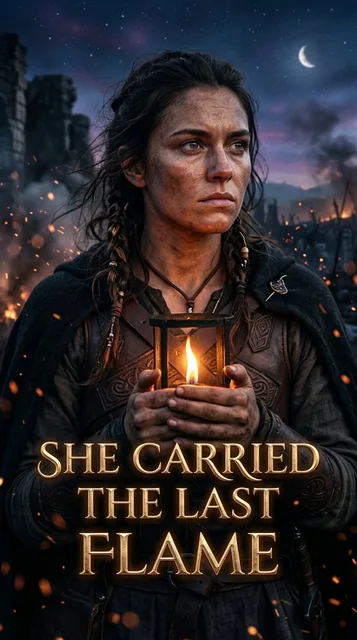
Chapter 1: The Border Runs Both Ways
The tree line was the only law that mattered.
Saoirse had known this since she was eight years old, standing in the snow with her father's hand on her shoulder and his voice in her ear, low and certain, the way he only spoke when something was true enough to outlast him.
The Ashveil pack does not cross the white pines. We do not cross them either. The moment someone forgets that, people die.
She had not forgotten.
She stood at the tree line now, boots planted in the half-frozen mud of early spring, watching the fog curl through the pines like something alive. The white bark of the trees caught the thin morning light and threw it back pale and cold. Beyond them was Ashveil territory. Beyond them was everything she had been trained to treat as a wound that had not finished bleeding.
She was not here to cross.
She was here because Brann had sent her, and when the war chief of the Dorrano pack sent you somewhere, you went.
Saoirse pulled her coat tighter and tilted her face into the wind. The air here smelled like iron and old snow and something she had no name for, a dry electric scent that raised the hairs on the back of her arms even through the wool.
She did not like it.
Behind her, footsteps. She did not turn.
"He's going to ask you again," said Riven.
Saoirse exhaled. Riven had a talent for announcing things she already knew. It was one of the many things about her oldest friend that she had never figured out how to love properly.
"I know."
"And what are you going to say?"
"The same thing I said last time."
Riven moved up beside her. He was a tall man, rangy and dark-haired, with the kind of face that looked gentle until you noticed the eyes. He looked at the white pines the way most people looked at open graves.
"He's not going to stop asking, Saoirse."
"He never does."
She turned away from the trees at last and started back toward the encampment. The path wound through birch and ash, familiar under her feet even in the grey light. She had walked it so many times she thought she could probably do it blind.
She probably would have to, eventually.
The mark on her left palm pulsed once, a faint warmth that had nothing to do with the cold. She pressed it against her thigh and kept walking.
Three years since the mark had appeared. Three years since she had woken in the night with her hand on fire and no source of flame anywhere near her. Three years since Brann had looked at the spiral scar burned into her palm and said, in a voice she had never heard from him before, the words she had spent every day since trying to unhear.
You are the last one.
The camp was waking around her as she walked in, smoke rising from the cook fires, the low sound of voices and movement that was the only kind of morning the Dorrano had known for years. There were perhaps three hundred of them left. Once there had been more than a thousand.
She did not let herself think about that number.
Brann's tent was at the center of the camp, as always. A man of ceremony, her war chief, even when there was nothing left to celebrate. The tent was large and patched and had survived six winters and two river crossings, and it still bore the mark of the old pack on the canvas, a wolf's head over crossed pine branches, the ink long since faded to grey.
She pushed inside without announcing herself. He had given her that right a long time ago.
Brann was at his table, bent over a map that Saoirse recognized. She had looked at that map herself, too many times, in the small hours when the camp was quiet and her mind would not rest.
He did not look up.
"You've been to the tree line again," he said.
"I go every morning."
"I know." He straightened then, and she saw how tired he was. Brann was not an old man but he wore his age in his face now, in the hollows beneath his eyes and the set of his jaw. The war had done that. The years of holding what was left together had done the rest.
He looked at her for a long moment before he spoke.
"I need you to cross."
The silence after those words was very complete.
Saoirse had known it was coming. She had known for weeks, since the scouts brought back reports of movement in the Ashveil lowlands, of soldiers in grey coats and something else, something the scouts had struggled to name, a brightness in the dark that one of them had described, haltingly, as like a lantern with nothing inside it.
She had known Brann would eventually point at the mark on her palm and the map on his table and her name and ask her to be the answer to a question nobody else could solve.
She had known.
It did not make it easier to hear.
"The border has held for three hundred years," she said.
"The border is a courtesy. And courtesies end." He moved toward her, stopped just short of reaching out. "What they are moving in the lowlands, the light the scouts described. You know what that is."
She did.
She wished she didn't.
"A containment construct," she said, keeping her voice flat. "A cage, built from nulled magic. Large scale."
"Large enough for an entire valley."
She went still.
"The Verath Valley," Brann said quietly. "Where the last wildfire roots grow. If they seal it off, there is nothing left in this territory that carries any trace of the old power. Nothing that can stand against what they're building."
Except her.
He didn't say it. He didn't have to.
The mark on her palm burned warm and steady, like a held breath.
"I need you to cross," Brann said again. "I need you to reach the valley before they seal it. I need you to find out what they're building and bring that information back."
Saoirse looked at the map. Looked at the white pines on its edge, drawn in pale ink like a scar across the land.
"And if I'm caught?"
Brann was quiet for a moment.
"Then do not be caught."
It was not an answer. It was the only answer he had, and they both knew it.
She looked at the map for a long time. She looked at the valley, small and green at the center, and at the grey territory around it that had been the enemy's for longer than she had been alive.
She thought about her father's voice.
The moment someone forgets, people die.
She picked up the map and folded it into her coat pocket.
"I leave at dawn," she said.
She was at the tent flap when Brann spoke again, his voice lower this time, stripped of the weight of command.
"Saoirse. Be careful."
She did not answer that either.
Outside, the mark on her palm had gone quiet again, banked and patient.
She pressed her fist against her chest and tried not to think about what waited on the other side of the white pines.
She failed.
Chapter 2: What the Fog Keeps
She crossed at the grey hour before sunrise, when the light was neither one thing nor another and the fog sat thick between the pines.
The border had no gate. No wall. It was only trees, white-barked and very old, and the understanding between two peoples that the space between them was sacred by necessity rather than choice. Sacred in the way that a loaded bow pointed at your face was sacred.
Saoirse moved through the pines with her pack on her back and the map folded against her ribs and her breath measured, deliberate, careful.
The moment she passed the first white trunk, something changed.
It was not loud. It was not dramatic. It was the way a room feels when you realize you are not alone in it. A pressure at the edges of her awareness, fine and persistent, like a needle drawn slowly across skin.
She kept moving.
The mark on her palm pulsed twice. She pressed her hand flat against her thigh and told it to be quiet.
The forest on the Ashveil side was older than the forest at home. She noticed that immediately. The trees here had a different quality of silence, a heaviness, as if they had been listening for a very long time and had not yet decided what to do with what they'd heard. The undergrowth was darker and the paths, when she found them, were worn not by boots but by years.
She did not take the paths.
Riven had given her a route before she left. He had drawn it from memory, from the accounts of the three scouts who had come back from inside Ashveil territory in the last five years, and he had made her memorize it before he burned the paper.
She ran it through her head as she walked. Northeast through the old growth, away from the patrol circuits, down the long slope toward the Keth River, then south along the bank where the canopy was thick enough to cover movement.
She had two days to reach the valley.
She did not think about what two days inside enemy territory meant for a woman carrying a mark that the Ashveil court had spent three centuries outlawing.
She thought about the route. She thought about her breathing. She thought about the weight of the pack and the condition of her boots and whether she had packed enough of the powdered bark Riven insisted on for waterproofing.
She was very good at thinking about practical things. She had spent years cultivating that skill.
By the time the light had shifted from grey to a thin, watery gold, she had put perhaps four miles between herself and the white pines. The slope was beginning to fall away beneath her feet, the ground softening as she moved toward lower elevation.
She stopped at the crest of a ridge and looked out.
Below, the Ashveil lowlands spread in the morning haze, fields and settlements, the grey threads of roads, and in the far distance, barely visible through the fog, the dark line of a river she thought must be the Keth.
It looked nothing like a territory at war.
That was wrong, she thought. Places at war looked like places at war. They looked like the Dorrano encampment, scattered and watchful and worn thin. They looked like the faces of people who had stopped expecting things to improve.
The Ashveil lowlands looked like a country going about its business.
Which meant the war it was waging happened somewhere else, on someone else.
She had always known this. It was different to see it.
She turned away from the view and started down the slope.
She did not hear the man until he was already close.
That was what frightened her most about it, later, when she had time to be frightened. She was good in the field. She had been trained since adolescence for exactly this kind of movement, quiet and careful and alert. She should have heard him.
She didn't.
One moment the forest was empty around her. The next there was a sound, a single deliberate footstep on the loose shale of the slope above her, placed exactly where she would place it if she wanted someone below to hear.
She spun.
He was perhaps twenty feet up the ridge, standing between two trees, and he was looking directly at her.
The first thing she registered was that he was not in uniform. Ashveil soldiers wore grey coats with the court seal at the collar. This man wore dark travelling clothes, a long coat, boots worn to the same mud color as the hillside, and nothing at his collar at all.
The second thing she registered was that he was very still.
Not the stillness of someone who had not noticed her. The stillness of someone who had been watching for some time and had decided, at this precise moment, to let her know it.
She did not reach for the knife at her belt. Not yet.
"You're off the marked trails," he said.
His voice was low and even, with the particular quality of someone who did not raise it often because they had never needed to.
"So are you," she said.
A silence. He looked at her the way people looked at things they were trying to identify. Not hostile. Not warm. Precise.
"The marked trails lead to checkpoints," he said. "I avoid checkpoints."
"Interesting thing to say to a stranger."
"You're moving northeast through Ashveil land at dawn with a pack on your back and no coat insignia. You're not a courier. You're not local. You cross like someone who has been trained to." He paused. "I thought you should know that someone else noticed before a checkpoint soldier did."
Saoirse kept her face neutral. Her heart was doing something unhelpful against her ribs.
"That's generous of you," she said.
"It's practical." He shifted, and she saw then that he was carrying nothing. No pack, no visible weapon, though that meant nothing. She had learned a long time ago that the most dangerous people often traveled light. "There's a patrol circuit that crosses this ridge at half past the morning bell. If you're standing here when it does, your morning gets significantly more complicated."
She should not trust this. She should not trust him. He was Ashveil, presumably, or at least inside Ashveil territory, which amounted to the same thing.
And yet.
The patrol, if he was telling the truth, was a problem she had not accounted for.
"How long?" she asked.
"Perhaps forty minutes, now."
She looked at the slope. Looked at him. He had not moved toward her. He had not made any gesture toward the knife she could now see at his hip.
"Northeast is bad," he said. "The patrols run wide on the north side of the ridge. South is cleaner."
"South puts me off my route."
"South keeps you alive long enough to have a route."
She did not like this. She did not like any of this. She especially did not like the fact that he was calm, and she could not figure out why.
"Why are you telling me this?" she asked.
He was quiet for a moment. Not thinking, she sensed. Choosing.
"I don't know yet," he said.
Then he turned and moved away through the trees, unhurried, noiseless, gone before she had fully registered he was leaving.
The forest was very quiet in his absence.
Saoirse stood on the slope and breathed and told herself the warmth in her left palm was just her imagination.
Then she turned south.
She did not know his name. She did not know what he was doing in the forest at dawn or why he had chosen to speak to her or what it meant that he had walked away without asking her a single question about who she was.
She knew only that he moved like someone who had been trained the way she had been trained.
And that, for reasons she could not explain, she had believed him.
She pushed south through the trees and did not look back.
But she thought about his voice for the next three miles, steady and precise in the morning cold.
And she could not entirely account for that.
Chapter 3: The Shape of a Name
She made the river by midday.
The Keth was lower than she had expected, running clear over dark stones, the banks thick with the bare architecture of early-spring willows. She moved along the southern bank as Riven's remembered route had told her to, keeping the water to her right and the treeline close on her left.
She stopped once to drink and eat, crouched at the water's edge, watching the far bank for movement. There was none. The land here felt uninhabited, though she knew it wasn't. The Ashveil built in clusters, settlements pulled tight around their trade roads, which meant the spaces between were genuinely empty.
She ate cold bread and dried meat and thought about the man on the ridge.
She should not still be thinking about him. She had filed him under threat-unclear and moved on. That was the correct procedure. That was what Riven had trained her to do with situations she couldn't fully read.
The correct procedure did not seem to be working.
The thing that kept returning to her was not his face, which she had only half-seen in the morning shadow, and not his voice, though that was difficult to fully set aside. It was the stillness of him. The quality of attention. She had met soldiers who were calm and trackers who were quiet and fighters who held themselves economically and none of them had combined those things in quite that arrangement.
He had warned her and then left. He had not asked for anything. He had not even asked her name.
She, in turn, had not asked his.
She packed her food away and stood and made herself think about the valley.
Two days. Less now. She needed to reach the Verath Valley before the Ashveil court's engineers completed their containment construct. She needed to see what they were building, map it as well as she could, and carry that information home.
Simple. Clear. Achievable.
She repeated those words to herself as she walked.
The afternoon passed in the grey rhythm of travel, the river beside her, the sky above going heavy and white with the promise of rain. She crossed a wooden footbridge at a place where the bank narrowed, moving fast and low, and made it to the far side without incident.
The valley was supposed to be visible from the ridge she was heading toward. She wanted to see it before dark.
She was an hour from the ridge when she heard voices.
She dropped without thinking, flattening into a stand of dry bracken, her hand already on the knife. The voices were male, two of them, carrying the particular casual cadence of people who did not expect to be overheard. She could not make out words yet but the direction was clear: they were moving along a track that cut across the slope above her.
Patrol.
She stayed down and counted.
The voices grew and peaked and faded. She gave them another count of two hundred before she moved. When she finally came up off the ground she was careful and deliberate, checking each direction before she straightened.
The track they had used crossed her route at a right angle. She was going to have to cross it.
She did it in four quick steps and kept moving.
The ridge came up through the late afternoon, steep enough that she was using her hands on the last stretch, pulling herself up by root and rock, her breath coming harder now. She reached the top as the light began to go warm at the edges and crawled to the crest on her belly.
She looked down.
The Verath Valley spread below her in the last of the afternoon light, and it was the greenest thing she had seen in years.
She had not expected that. She had built a picture in her head based on the scout reports and the map, something functional and tactical. She had not expected to look down and feel something in her chest shift at the sight of it.
The valley was roughly oval, maybe two miles across at its widest. The floor was thick with the old growth that gave it its value, wildfire root and aelder fern and the grey-green of heartsbriar, plants that needed old magic in the soil to survive and that had been dying for three centuries everywhere else. Here, somehow, they remained.
At the valley's edge, to the south and east, she could see them.
Structures. Metal towers, perhaps fifteen feet tall, arranged in a pattern she recognized from Brann's description even from this distance. The containment construct was already partially raised, a skeletal cage of treated iron and something else, something that glinted wrong in the lowering light.
Nulled glass, she thought. Shaped and set to block what the iron alone could not.
Her stomach tightened.
They were further along than the scouts had reported.
She counted the towers she could see. Eight visible on the east side alone. How many on the west, hidden from her angle? How many already complete?
She needed to get closer.
She needed to be very stupid, apparently.
She was mapping the descent, calculating angles, when a sound behind her made the back of her neck go cold.
One footstep. Placed with absolute precision on the rock behind her.
She did not spin this time. She rolled, coming up with the knife already drawn, and came to her feet in a crouch with the blade between her and the sound.
He was standing at the crest of the ridge five feet away, his hands open at his sides, looking at her with an expression that might, in other circumstances, have passed for mild.
The man from the morning.
She did not lower the knife.
"You followed me," she said.
"You went south," he said. "South of the Keth ridge leads here, unless you're spectacularly lost."
"I'm not lost."
"I know."
He looked at her steadily. In the better light she could see him more clearly now, somewhere in his late twenties, dark-haired, with the kind of face that had been constructed without particular concern for beauty but had arrived there anyway. There was a scar along his jaw, old and well-healed, and his eyes were the complicated color of river water in shade.
She kept the knife where it was.
"What do you want?" she asked.
He glanced past her, down into the valley, and something moved in his expression that she could not entirely name.
"The same thing you want," he said. "I think."
"That is an extremely unhelpful answer."
"I know that too." He brought his gaze back to her. "My name is Caelum."
She did not give him hers.
He noticed. He did not push.
"You're looking at the construct," he said. It was not a question.
"So are you."
"Yes." A pause. "I helped design it."
The silence after that was very complete.
Saoirse looked at him. She looked at his open hands and the absence of urgency in him and the careful way he was standing, not close, not threatening, and not making any of the moves she would make if she intended harm.
She thought about what it meant that a man who had helped design the thing she had come here to stop had followed her across half a day's travel and was now standing on a ridge at twilight telling her his name.
"Why are you telling me this?" she asked.
It was the same question she had asked this morning.
He gave her the same answer.
"I don't know yet."
But his eyes, when he said it, had gone to her left hand.
To the place where the mark was hidden beneath her glove.
And something in his face, just for a moment, looked afraid.
Chapter 4: Men Who Build Cages
She did not sheathe the knife.
She stood on the ridge in the failing light with the blade between them and watched his eyes move from her hand to her face and thought about every scenario in which this ended well.
She could not find many.
"You know what I am," she said.
It was not a question. His reaction had told her that much. The brief shift in his expression, controlled almost immediately, but not quite fast enough.
Caelum let a beat pass before he answered.
"I know what the mark means," he said. "Yes."
"Then you know what the Ashveil court would give to have me in custody."
"Considerably more than they'd give for me." He did not move. "I'm going to sit down. If that's all right."
She stared at him.
He sat down on the rock at the crest of the ridge, knees up, forearms resting on them, in the posture of a man who had decided to make himself as unthreatening as possible and was being deliberate about it.
She remained standing.
"You helped design the construct," she said.
"I drew the structural plans. I calculated load distribution for the nulled glass settings." He looked out over the valley, not at her. "I didn't know what it was for, at first. I was told it was containment infrastructure for an unstable geological site."
"And when you found out the truth?"
A silence.
"I'm sitting on a ridge in the dark talking to a woman with a knife," he said. "Draw your own conclusions."
Saoirse turned this over. She was good at reading people. It was a skill she had developed by necessity, living in a camp where a wrong read could cost more than embarrassment. She read Riven, who was opaque by habit and architecture. She read Brann, who was honest but rarely simple.
She read this man and got something she had not expected.
Conflict. Genuine and unresolved.
"How many towers on the west side?" she asked.
He looked at her. She saw him decide something.
"Six complete. Three in progress."
She did the calculation. Seventeen total, at minimum. The construct needed twenty-four to fully seal the valley. They had more time than she'd feared.
"When do they expect to complete it?"
"The official timeline is twelve days. The site engineer is behind schedule. Realistically, perhaps eighteen."
"Realistically according to who?"
"Me." He looked back at the valley. "I'm the only one who knows the actual numbers."
She finally lowered the knife, though she did not put it away.
"You're going to tell me why you're here," she said. "All of it."
Caelum was quiet for long enough that she thought he might refuse. When he spoke, he did it slowly, as if choosing each word from a larger supply and discarding the ones that weren't precise enough.
"I was raised by the court," he said. "Not born into it. Taken in. I was eight years old and I had a specific skill with structures and numbers that made me useful to them, and so they made me into something useful."
He paused.
"I have spent nineteen years building things for the Ashveil court. Bridges. Aqueducts. Fortifications. I built what they pointed me at and I told myself that infrastructure was neutral, that the politics around it were not my concern."
"And the construct."
"The construct is not neutral." He turned and looked at her directly for the first time since he'd sat down. "What the valley contains is not dangerous. It is the last of something. And the court wants to silence it not because it threatens them but because they are afraid of what it will mean if the old power is remembered."
Saoirse was very still.
"If the sealing completes," he continued, "the wildfire roots die. The last growing ground for the old-growth plants goes dead within a season. And anything that draws from those roots, anything that is fed by that particular trace of power in the soil, dies with them."
He looked at her hand. Her gloved hand.
She understood what he was saying.
If the valley was sealed, whatever sustained the mark on her palm would have no anchor left in the world. Whether that would kill the flame itself or only sever its deepest root, she did not know. She was not certain the distinction mattered.
"Why are you telling me this?" she asked. Third time now.
This time he did not say he didn't know.
"Because I spent three months building the thing," he said, "and I have been trying to figure out for six weeks how to stop it, and I haven't been able to do it alone."
The valley was in shadow now. The construct towers caught the last of the light at their tops, glinting cold and clean.
"You want my help," she said.
"I want us to not be on opposite sides of this."
"We are on opposite sides of this. You live here. I crossed the border to stop what your court is building."
"I know." He met her eyes. "I'm asking you to let that be complicated."
She looked at him for a long time.
She thought about Brann, who had sent her here for information and not for alliances. She thought about Riven, who would say that a man who helped design your enemy's weapon and then offered to defect was almost certainly a trap.
She thought about the valley below, green and quiet in the gathering dark, and the towers at its edge, and the eighteen days.
She sheathed the knife.
"I'm going down into the valley tonight," she said. "I need to map the existing towers and assess the construction approach."
He said nothing.
"You can come," she said, "or you can stay here. But if you come, you walk where I walk and you do not speak unless I ask you a question."
A pause.
"Understood," he said.
He stood and fell in behind her without further comment, and she turned her back on him and started down the ridge and tried very hard not to think about the fact that she could not hear his footsteps behind her.
Quiet as water. Quiet as a held breath.
She did not like how much she noticed that.
Download Novelle to read more chapters for free